
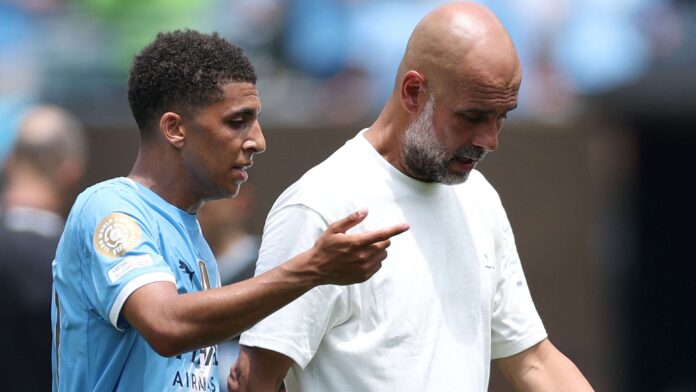
Pep Guardiola has indicated he is unlikely to make sweeping changes to his team when Manchester City face Real Madrid in Wednesday’s Champions League showdown, suggesting the demands of the moment call for stability rather than experimentation.
City arrive in Spain on the back of a composed and authoritative 3–0 win over Sunderland at the Etihad Stadium — a result that not only helped close the gap in the Premier League title race but also reinforced a sense of momentum following Arsenal’s slip against Aston Villa.
The victory carried an air of control that City have not always shown this season, and the performance may have arrived at precisely the right time with the Bernabéu trip looming.
The efficiency of the performance, combined with the assertive scoreline, only strengthened the impression that Guardiola has recently favoured consistency over squad rotation.
The defeat to Bayer Leverkusen in City’s previous Champions League outing appeared to spark introspection around team selection, and the manager’s decisions since then have pointed towards a desire for rhythm, cohesion and predictability in a period where every match carries weight.
Manchester City face Real Madrid in Wednesday’s Champions League showdown in a fixture loaded with both history and consequence — squad rotation naturally emerged as a talking point after the Sunderland match.
Guardiola faced a series of questions about whether he would revert to a more experimental approach in midweek or continue to stick closely to his established core.
His answer, delivered with a smile, suggested the latter:
“No, you destroyed me. So I said I don’t want to be destroyed again for substitutions. I want to be kind to you,” he said in response to a reporter, a light-hearted acknowledgement of scrutiny he has faced over changes in previous matches.
Guardiola’s comments imply that only minimal adjustments are expected on Wednesday, with the emphasis firmly on preserving the connections that have helped City regain form after the Leverkusen setback.
Several key individuals appear to be peaking at the right time, and the manager seems reluctant to disrupt that flow.
Erling Haaland’s sharpness in front of goal has improved steadily over recent outings, and Phil Foden continues to be one of City’s most influential performers, drifting fluidly between lines and driving the team forward.
Rayan Cherki’s ability to dictate tempo, coupled with Nico Gonzalez’s reliability in midfield, has further contributed to a sense of tactical calm that City will likely want to carry into Madrid.
The defensive axis of Dias and Gvardiol has also begun to look increasingly settled. Dias, revitalised after a patchy early-season spell, has rediscovered the commanding presence that marked his previous campaigns.
- Former Chelsea player emerges contender to succeed Guardiola as Man City boss
- Six top Real Madrid players who will miss Manchester City clash
Gvardiol, meanwhile, has grown progressively more comfortable in both central defence and the hybrid roles Guardiola has asked of him. Against Sunderland, his goal was merely the most visible expression of a broader influence on City’s structure.
Guardiola has spoken in recent weeks about the importance of emotional and tactical balance during intense fixture periods.
The defeat in Germany appeared to underscore the risks of over-rotation, particularly when opponents possess the capacity to punish disjointed performances.
Meanwhile, the Bernabéu has witnessed several dramatic encounters between the sides in recent seasons, with both teams enjoying moments of ascendancy.
Madrid’s ability to shift matches through quick-fire bursts of quality makes them uniquely dangerous, and Guardiola is acutely aware of the need for competitive rhythm in such an environment.