Manchester City left north London frustrated after surrendering a two–goal advantage against Tottenham Hotspur, with Pep Guardiola particularly angered by the circumstances surrounding Spurs’ opening goal.
The City manager felt the strike should have been ruled out for a foul on defender Marc Guehi, an incident that later prompted the Premier League to issue a formal explanation of the decision taken by the officials and the Video Assistant Referee.
City had appeared in complete control during the early stages and looked set for a comfortable evening. Yet the match turned dramatically after the interval, allowing Tottenham to recover and claim a valuable draw.
While the contest was entertaining for the neutral, the debate that followed centred less on the football itself and more on the interpretation of one pivotal moment.
Guardiola’s side began with authority and quickly imposed their passing rhythm on a Spurs team that initially struggled to settle.
Inside the opening 11 minutes the visitors were rewarded for their bright start when Rayan Cherki broke the deadlock. The French forward, lively throughout, cut inside onto his stronger foot and sent a low drive beyond Guglielmo Vicario.
The Tottenham goalkeeper stretched but could not prevent the ball from creeping into the corner, giving City an early platform.
Confidence flowed through the Cityzens and they doubled the lead before the break through Antoine Semenyo.
Tottenham were being forced deeper and deeper, and there was little suggestion that the pattern of the game would change.
City supporters inside the Tottenham Hotspur Stadium expected their team to manage the second half professionally and move a step closer to the summit of the table.
Football rarely follows such simple scripts. The home team adjusted their approach during the interval, encouraging his players to press higher and deliver quicker service into Dominic Solanke.
The striker, who has endured an injury-hit campaign, responded emphatically. Within 17 minutes he scored twice to haul Spurs level and ignite the home crowd.
The first of those goals, arriving in the 55th minute, proved to be the flashpoint. Solanke challenged Guehi as a cross dropped into the City penalty area, and the ball eventually found its way past Gianluigi Donnarumma.
At first the strike was recorded as an own goal from Guehi, who only joined City from Crystal Palace in January, but it was later credited to Solanke after further review.
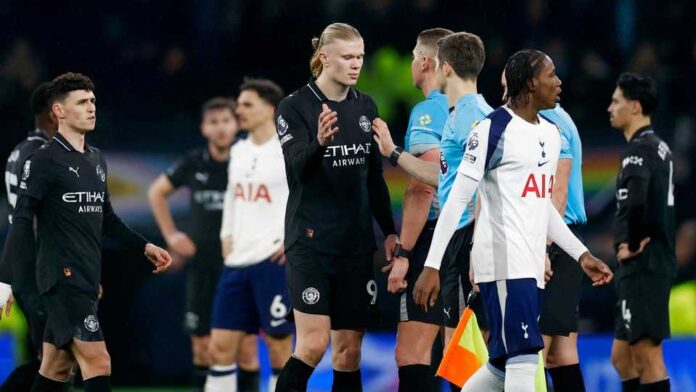
City players surrounded the referee, arguing that their defender had been impeded before the ball crossed the line. Replays showed Solanke’s follow-through making contact with Guehi’s leg as the pair attempted to reach the ball.
Despite the protests, VAR opted not to recommend an on-field review, allowing the goal to stand.
Premier League clarify VAR judgement
Guardiola’s frustration was evident on the touchline and continued after the final whistle. He insisted that the challenge met the threshold for a foul and questioned why officials had not intervened.
With the result leaving City many points adrift of the leaders, the Spaniard described the decision as “difficult to accept”, though he also acknowledged his side should have managed the second half more effectively.
- Tottenham 2-2 Man City: Guardiola hails four Man City heroes despite ’embarrassing’ draw
- Klopp shocks fans by admitting he’d work as Guardiola’s assistant
As debate intensified online and across television studios, the Premier League Match Centre moved to explain the reasoning behind the officials’ call.
In a message posted on social media, the organisation defended the process followed by VAR and the goal accreditation panel.
“The referee’s call of goal was checked and confirmed by VAR – with the challenge by Solanke on Guehi deemed not to be a foul as Solanke played the ball. The goal accreditation panel has adjudged the goal to be a Solanke goal.”
The statement made clear that, in the view of the review team, Solanke’s touch on the ball occurred before any significant contact with Guehi.
Under current guidelines, such challenges are considered legitimate provided the attacker’s primary action is to play the ball rather than the opponent.
The explanation, however, did little to calm City supporters who felt their team had been denied a fair outcome.