
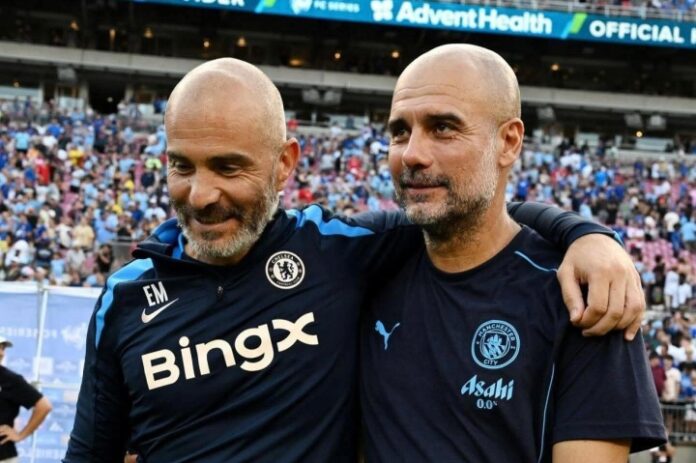
Chelsea’s decision to part company with Enzo Maresca came suddenly, but the events that led to his exit had been building quietly for weeks.
While public focus fell on post-match comments and growing tension behind the scenes, there was another factor working in the background: Manchester City’s interest in Maresca and the manager openness about it.
The Italian coach, once regarded as a progressive appointment aligned with Chelsea’s evolving project, found himself caught between ambition and timing.
His past association with Pep Guardiola, combined with City’s routine succession planning, created an atmosphere that became increasingly uncomfortable at Stamford Bridge.
What follows is how those strands came together, and why City’s interest, however informal, became part of a wider chain reaction.
City links, Chelsea nerves and a fragile balance
Chelsea were not unaware of Manchester City’s interest in Maresca. Sources close to the club indicate that senior figures had been informed, on more than one occasion, that the former Leicester City boss was speaking to individuals connected to City about a possible future vacancy at the Etihad Stadium.
According to The Athletic, Maresca first raised the subject in late October and again in mid-December, explaining that discussions were exploratory and centred on the long term.
From Chelsea’s perspective, the conversations were initially seen as routine. Elite clubs regularly conduct background checks and sound out potential candidates, particularly when a manager of Guardiola’s stature inevitably attracts speculation.
At that stage, there was no suggestion that City were preparing to move imminently. Guardiola still had time left on his contract, and there had been no formal approach.
Internally, Chelsea did not believe Maresca was on the brink of leaving, nor did they see the situation as destabilising.
However, the dynamic shifted as Maresca appeared to place increasing emphasis on the interest. While City were simply doing what many top clubs do, Chelsea sensed that their head coach might be overplaying the significance of those informal contacts.
That unease intensified after Chelsea’s Premier League win over Everton on December 13. Speaking publicly after the match, Maresca delivered comments that surprised and unsettled the club’s leadership.
“Since I joined the club, the last 48 hours have been the worst because many people didn’t support us.”
The remark, widely reported, was interpreted as a criticism of the club’s hierarchy rather than external noise. Sources say Chelsea co-owner Behdad Eghbali was particularly troubled, feeling the comments crossed an internal line by bringing private frustrations into the public domain.
From that point on, trust began to erode. While the City links had not been decisive on their own, they now formed part of a broader picture: a manager perceived to be looking ahead while the club expected complete focus on the present.
Chelsea moved quickly. Behind the scenes, contingency planning accelerated, and attention turned to possible replacements. One name that emerged prominently was Liam Rosenior, the 41-year-old head coach of Strasbourg.
Like Chelsea, the Ligue 1 club is owned by BlueCo, making any potential move structurally straightforward.
Within days, Maresca was gone. Chelsea felt the relationship had reached a point of no return, shaped by public criticism, internal strain and a sense that external interest had become a distraction rather than background noise.
Guardiola’s stance and why City were never the driving force
It is important to stress that Manchester City’s interest in Maresca and the club role was indirect. Sources close to the Sky Blues insist there was never a formal approach for Maresca, nor any attempt to unsettle Chelsea.
City did not deny that Maresca’s name was discussed internally, but they maintain this was no more than standard due diligence.
Graeme Bailey, TEAMtalk’s transfer insider, explained that City’s actions were routine rather than strategic.
“The board knew about Man City doing their due diligence with Maresca, but that was not seen as a huge issue at the time.
“It’s never ideal when a manager is linked, but Man City were just doing work on potential candidates in the off-chance Guardiola goes – it was not as if they were making approaches this season.
“Did Maresca more of it? Possibly, and let’s be honest, it clearly didn’t help this whole situation, but it was his public comments that were the domino effect that began this situation and could not be stopped.”
From City’s perspective, the context is clear. Guardiola has repeatedly dismissed speculation about his immediate future and has shown little appetite for stepping away. Speaking on December 19, the City manager addressed the recurring questions directly.
“The last three or four years, every time during a certain period, someone asks me that question.
“Sooner or later, when I’m 75 or 76, I will quit Manchester City!
“I understand the question when I have the end of a contract (coming), but I have 18 months left, and I am so delighted and happy and excited about the development of the team and being there. That is all I can say.
“That question happens every single season at a certain point and I’m OK. The club and I are incredibly connected in terms of the decisions we have to take and when it’s going to happen, it’s going to happen.
“There are no discussions – end of the subject. There are no discussions. I will not be eternally here, but I’ve said before I will not be here forever. None of us will be forever in this world, but there are no discussions.
“What is going to happen will happen, and the club has to be prepared for everything – for the players and the CEOs, except the owners. They are here unless they are going to sell the club, which I don’t think will happen.
“The rest, the club has to be prepared but that subject is not on the table right now.”
- Guardiola sends clear message to Rodri on how to become best player again
- Manchester City submit €25 million offer for young Barcelona superstar – report
When asked directly if he would still be in charge next season, Guardiola was unequivocal.
“I’m here. What’s going to happen who knows but if I have 10 years on my contract or six months, football changes a lot.
“Now I’m focused on West Ham and go for a few days with my dad and that’s all, come back for Nottingham (Forest) and Sunderland and Brighton and Chelsea.”
Those comments underline why City’s interest never amounted to more than planning for the future. For Chelsea, though, the damage had already been done.
In an environment where stability and alignment are paramount, even the perception of divided attention can be costly.
Therefore, the shocking dismissal was not triggered by Manchester City’s interest in Maresca. Instead, it was shaped by how that distant possibility was handled, communicated and ultimately overshadowed by public dissent.
City’s shadow loomed quietly in the background, but it was Chelsea’s loss of confidence that brought the curtain down.