
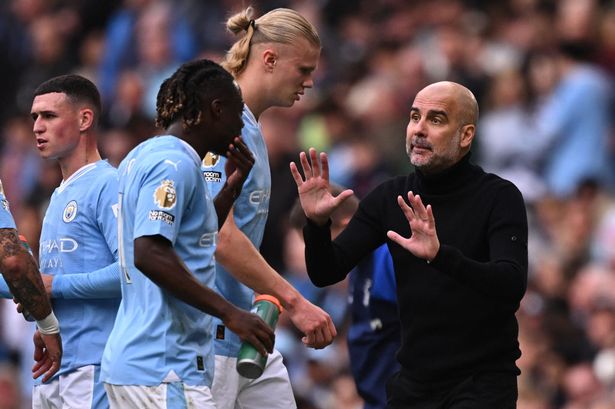
Manchester City manager Pep Guardiola has opened up on the emotional strain facing Erling Haaland, acknowledging that the prolific forward has been wrestling with frustration during a rare run without goals from open play.
The Norway international, usually so reliable in front of goal, has gone eight Premier League matches without finding the net in normal play – an unfamiliar drought that has sparked debate about his form and fitness.
Guardiola, speaking after City’s dramatic victory over Liverpool, offered a candid insight into the mindset of his leading scorer.
Rather than questioning Haaland’s commitment, the Spaniard praised the striker’s desire to deliver for the team and explained how deeply he feels the responsibility of leading the line for the Sky Blues.
“He’s calm but he puts pressure on himself,” Guardiola said during an interview. “He knows how much we need him and he doesn’t want to leave the team disappointed.
“That is a big attribute, I prefer that than ‘I don’t care’ – he’s completely the opposite.
“He’s suffering when he doesn’t score a goal.”
Since arriving in England, he has rewritten scoring records and transformed the way the team attacks. Yet even players of his stature are not immune to difficult periods, and Guardiola believes the current challenges are part of a natural learning curve.
The pressure on Haaland was illustrated perfectly at Anfield on Sunday. With City trailing deep into stoppage time, the visitors were awarded a penalty that could rescue their title hopes.
Haaland stepped forward amid a hostile atmosphere and converted with confidence, earning his side a vital three points.
Guardiola described the moment as a true test of nerve. “I know it’s not easy,” he said. “Anfield 91, 92 minutes, and the situation that we have, taking that and with this composure.
“His body language, his eyes, there was fire there.
“Yeah, it’s not easy. That defines the good players.
“Hopefully it can lift him. The situation is he admits that he’s tired, a little bit down. It’s just one reason – it’s the calendar. No more than that.”
The manager’s reference to the relentless fixture schedule reflects a wider concern across the game. City are competing on four fronts and have played an intense sequence of matches at home and abroad.
For a player who relies heavily on explosive movement and physical power, the demands can take a toll.
Earlier in the campaign Haaland appeared unstoppable, scoring 19 goals in his first 17 appearances. Since then, however, he has managed only two in eight league outings, prompting questions about whether opponents have begun to find ways to contain him.
Guardiola insists such fluctuations are inevitable, particularly for a young player still adapting to the rhythm of English football.
“Erling, we cannot forget, he’s not 29, 30 years old, he’s young. It’s part of the process,” he explained.
“Every season he lives, he’s a better player for the next one. How he knows his body better, how he knows what it means to play everywhere or four days.”
Despite the recent slowdown, Haaland remains the Premier League’s top scorer and a pivotal figure in City’s pursuit of more silverware.
Guardiola was keen to remind critics how decisive the striker has been throughout the season.
- Man City vs Fulham: Guardiola confirms injury update, predicted XI and team news
- “We Won’t Win” – Guardiola reveals City’s biggest weakness before Fulham clash
“The last games, maybe he doesn’t have the numbers that he wants, but we are in the position that we are thanks to him,” the manager said.
“For three quarters of the season, if Erling didn’t score, I didn’t know who’s going to score.
“We are in a position in the Champions League, and especially in the Premier League that without Erling would not be possible.”
Those words highlight the dependence City have developed on the Norwegian. While the squad contains an array of creative talent, Haaland provides a focal point and a guarantee of goals that few teams in Europe can match.
Guardiola also addressed the psychological challenge of living up to extraordinary statistics. “The problem with Erling is that he has to deal with his own numbers, with his expectations,” he noted.
“It’s not easy to do that for many, many years. That is a challenge for him.”