Pep Guardiola offered what sounded like a routine closing remark, the kind managers deliver without much thought. Yet, as the words left his mouth, there was a sense they carried more weight than usual — not because of what was said, but how it was said.
“There are five (Premier League) games left and a Cup final,” he said. “Then holidays and come back next season.”
It was brief, almost dismissive, but it lingered. Guardiola is not known for breaking agreements, and his current deal with Manchester City extends until the summer of 2027.
Still, speculation about his future has refused to fade. The idea that this might be his final campaign in England has gathered momentum, with some already pointing toward Enzo Maresca as a possible successor.
Nothing has been confirmed, and perhaps nothing is imminent. Yet Guardiola’s mood — calm, composed, and quietly satisfied — suggested a man not preparing for an exit, but one still deeply engaged in the challenge before him.
A manager re-energised by the moment
There is a visible difference about Guardiola. Not necessarily relaxed — that would be overstating it — but certainly lighter in spirit. The tension that so often defines elite competition seems, for now, less pronounced.
On the touchline, he remains unmistakably himself: animated, demanding, and absorbed in every detail.
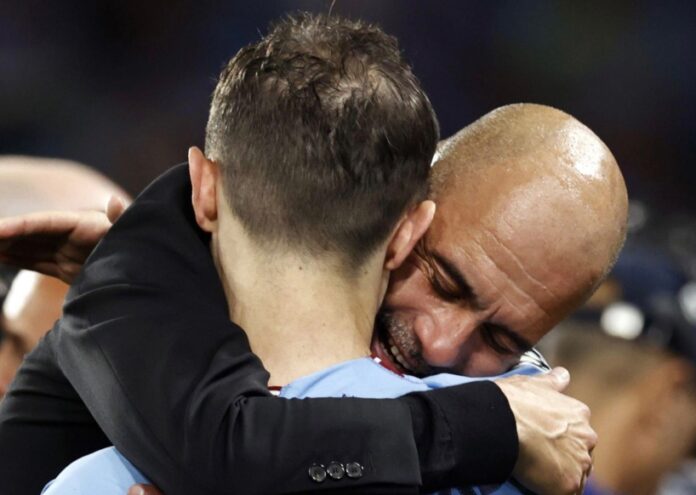
But away from the immediacy of the match, there is a noticeable ease. Following Manchester City’s latest victory at Wembley, sealed by a dramatic late strike from Nico Gonzalez, Guardiola appeared unusually at peace.
It was not just the result that shaped that mood, though reaching a record fourth consecutive FA Cup final provided its own satisfaction.
More telling was what followed. Guardiola granted his players time off until Wednesday afternoon, even allowing them to travel if they wished — a gesture that spoke volumes about his trust in the group and his confidence in their current condition.
That confidence has been built on progress. This version of Manchester City, reshaped and tested, has reached a point where belief feels justified.
Guardiola himself acknowledged the uncertainty that surrounded the team earlier in the campaign.
“After what happened last season, there was a question mark about this season. How would the players react?” he explained.
The answer, at least from his perspective, has been emphatic.
“We have arrived where the players are at their best moment. The club is defined by arriving at the later stages fighting for the title.
‘I am so proud of that. Of course, I love to lift titles but being there and not taking a step back, that defines a big club.
“Not all the clubs can win all the time but being there, fighting against Arsenal, against Liverpool in previous seasons, four FA Cups in a row, that is extraordinary. It is time to enjoy it.”
His words reflected both pride and perspective. Success, for Guardiola, is not measured solely in silverware, but in consistency — in remaining present at the decisive stages of competition, season after season.
Squad depth and the road ahead
If there was one aspect of the semi-final that particularly pleased Guardiola, it was the opportunity to rotate.
With a demanding stretch ahead — six matches in 21 days that could define their pursuit of multiple trophies — careful management of his squad is essential.
- Guardiola’s favourite player set for shock £78m Atletico Madrid move
- Pep Guardiola finally reveals game-changing secret he learnt after joining Man City
Even so, the match itself was not without tension. Southampton threatened to disrupt the occasion when Finn Azaz struck late to give them the lead.
For a brief moment, City’s progress was in doubt. But the response was swift. Jeremy Doku’s deflected effort restored parity before Gonzalez’s decisive intervention secured victory.
“Terrible! That’s why I felt I had to let all the players play today. You cannot manage these games with the same players. I need the squad,” he said when asked about the congested schedule ahead, beginning with a trip to Everton on May 4.
His subsequent praise for his players came freely and with genuine enthusiasm. Names were reeled off, contributions acknowledged, and potential highlighted.
Among those singled out was Matheus Nunes, whom Guardiola suggested “can be one of the best right-backs in the world.”