Manchester City left north London with frustration rather than victory after a dramatic 2–2 draw with Tottenham, a match that has reignited arguments about the VAR controversies in the Premier League.
Pep Guardiola’s side appeared to be coasting with a two-goal lead, yet the afternoon ended with arguments about officiating rather than football.
City had produced a commanding first-half display at the Tottenham Hotspur Stadium.
Goals from Rayan Cherki and Antoine Semenyo rewarded their dominance and suggested the champions were returning to the ruthless rhythm that has defined much of Guardiola’s reign. Spurs, disjointed before the break, looked short of ideas and energy.
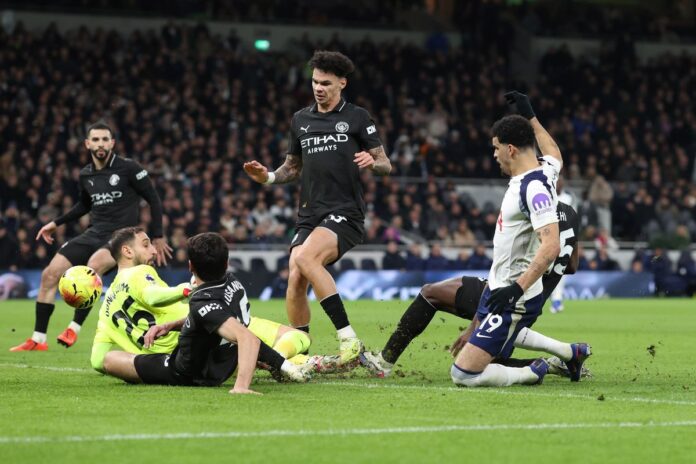
The mood shifted completely after half-time. Tottenham forward Dominic Solanke hauled his team back into the contest with two goals of real quality, the second an acrobatic scorpion-style finish that brought the stadium to its feet.
The comeback earned the host a valuable point and halted City’s attempt to close the gap on the league leaders.
Yet the spectacle of Solanke’s equaliser was quickly overshadowed by the circumstances surrounding his first strike and raises question about VAR controversies in the Premier League.
Television replays suggested the England striker had made contact with Marc Guehi before the ball ran loose for him to score. City players protested furiously, convinced a foul had been committed in the build-up.
VAR official Jarred Gillett reviewed the incident but decided not to recommend an on-field check for referee Rob Jones.
The goal stood, and the sense of injustice lingered long after the final whistle. For Guardiola, already wrestling with an inconsistent season, it was another moment that felt beyond his control.
City’s camp remained measured in public, though their irritation was obvious. The result leaves them further adrift in the title race and facing questions about their ability to manage matches when momentum turns.
Tottenham, by contrast, celebrated a show of resilience that reflected the character Postecoglou has tried to instil.
Former official delivers stinging verdict
The debate intensified when Keith Hackett, the former head of the Professional Game Match Officials Limited, reviewed the footage and delivered a blunt assessment.
Speaking to Football Insider, he argued that the decision not to intervene represented a failure of the system designed to correct such mistakes.
“When you look at the replay of the Tottenham goal,” he said, “It is rather surprising and disappointing that the goal was allowed.”
Hackett insisted the contact on Guehi was clear enough to warrant a review.
“Clearly, a foul had taken place prior to the ball going into the back of the net. Dominic Solanke kicks Marc Guehi in the back of the leg, that is a foul.”
His frustration centred on the passivity of the video officials. “Where was VAR? Allowing the goal was a clear and obvious error, VAR should have intervened.”
The veteran administrator believes an on-field check would have led to a different outcome.
“I have no doubt if the referee had the opportunity of going to the monitor, this goal would have been ruled out.”
- Premier League responds to Guardiola and fans outcry over Tottenham controversy
- Tottenham 2-2 Man City: Guardiola hails four Man City heroes despite ’embarrassing’ draw
Hackett concluded with a wider criticism of recent performances by officials. “It was another poor piece of officiating this weekend, which has not been good for match officials.”
The VAR controversies in the Premier League have become familiar arguments. It raises question about consistency and transparency in the officiating.
Supporters of VAR point to numerous occasions when the technology has corrected clear mistakes, yet incidents like this fuel claims that its application remains unpredictable.
For Guardiola, the focus must quickly return to football. His side showed in the first half the technical quality that has brought so many trophies, but they also revealed defensive vulnerability once Tottenham raised the tempo.
The manager has spoken repeatedly about the need for control during difficult periods, something City lacked after the interval.