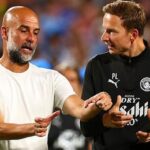
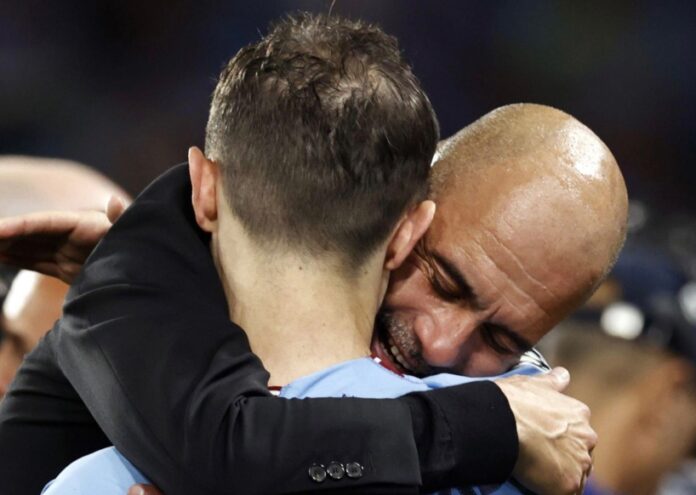
When Pep Guardiola arrived at Manchester City in 2016, the expectation was clear: transform a wealthy club into a football dynasty. Ten years later, he leaves having done far more than that.
The Spaniard departs as the architect of the most dominant era in City’s history, delivering 20 major trophies and reshaping English football through his relentless pursuit of perfection.
League titles, domestic cups and European glory turned City from contenders into a benchmark for excellence under Guardiola’s leadership.
Yet behind the celebrations surrounding his departure lies the story of a manager whose original vision stretched much further than a decade.
Reports suggest Guardiola had privately targeted an extraordinary personal milestone during his time in Manchester.
According to The Athletic, the City manager hoped to remain at the club long enough to secure 10 Premier League titles.
It was an ambition inspired partly by his admiration for American sport, where long-term records and historic landmarks carry enormous significance.
For a period, that target did not appear unrealistic.
City’s dominance across England made the idea seem achievable rather than fanciful. Guardiola’s side were setting new standards for consistency and tactical brilliance, collecting trophies at a relentless pace while redefining how the modern game could be played.
Their style combined technical precision with ruthless efficiency, leaving rivals struggling to keep up.
At one stage, it appeared Guardiola could stay indefinitely.
Instead, the mood changed dramatically following a rare disappointing campaign last season.
For the first time in years, City ended the season without a major silverware. The absence of trophies represented more than a temporary setback; it altered Guardiola’s outlook on the future and ultimately accelerated his departure from the club.
The disappointment appears to have forced a reassessment from a manager who has always demanded the highest standards from himself and his players.
Rather than continue pursuing the long-term objective he once envisioned, Guardiola decided the moment had arrived to step away earlier than expected.
Guardiola’s incredible legacy remains untouched.
Few managers in football history have transformed a club with such authority and consistency. Guardiola did not simply help City win trophies; he established a culture where success became expected every season.
His influence reached beyond results alone, shaping recruitment, tactical development and the club’s wider football identity.
Under his guidance, City became one of the most feared teams in Europe. The club’s attacking football, positional discipline and ability to control matches made them admired across the continent.
Players improved dramatically under Guardiola’s coaching, while younger talents were integrated into a structure designed for sustained success.
His record places him among the greatest managers English football has seen.
Only Sir Alex Ferguson remains ahead of Guardiola in terms of total honours won in English football. Ferguson’s achievements at Manchester United were built over 26 years at Old Trafford, a level of longevity rarely seen in modern football.
Guardiola’s time in Manchester was considerably shorter, making the scale of his achievements even more remarkable.
Had he continued collecting silverware at his usual rate, he may eventually have challenged Ferguson’s record despite spending far fewer years in English football.
That possibility will now remain one of the sport’s great hypotheticals.
Still, Guardiola leaves with little left to prove. He transformed Manchester City into serial winners and delivered memories supporters could scarcely have imagined before his arrival.
- Wayne Rooney blasts Man City after ‘Unbelievable’ farewell scenes for Bernardo Silva and John Stones
- Ex-PGMOL Chief slams ‘Unbelievable Nonsense’ in Man City vs Aston Villa VAR calls
Multiple league titles, domestic cup triumphs and European success ensured his reign will be remembered as one of football’s defining managerial eras.
Attention now turns toward the future and the enormous challenge facing the club after Guardiola’s exit.
Replacing a figure of his stature is never straightforward. Modern football history is filled with examples of clubs struggling after the departure of iconic managers.
City’s hierarchy will therefore understand the importance of appointing someone capable not only of winning matches, but also of maintaining the standards Guardiola established.
Current indications suggest Enzo Maresca is expected to take over the role. The Italian is already familiar with the environment and philosophy surrounding the club, which could help smooth the transition into a new era.