
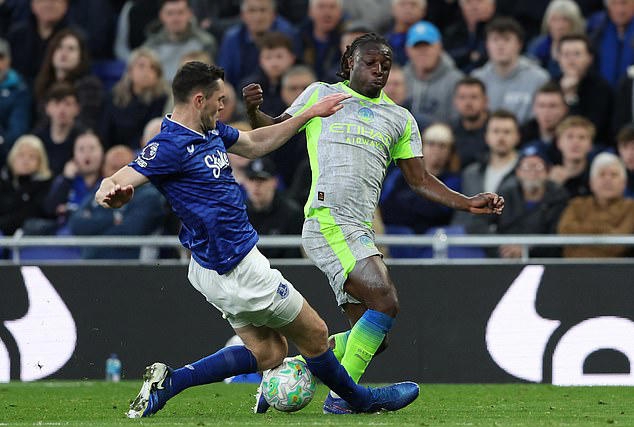
Manchester City’s late surge ensured they salvaged something from a contest that had threatened to slip away, but the talking point lingered around a contentious first-half decision involving Michael Keane and Jeremy Doku.
The incident, which unfolded just before the interval, has continued to divide opinion among pundits, officials and supporters alike.
At its core lies a familiar debate in modern football — the interpretation of dangerous play and the consistency of officiating standards in the age of VAR.
Former referees’ chief Keith Hackett has now weighed in with a firm assessment, suggesting that Everton defender Keane was fortunate to avoid being dismissed by referee Michael Oliver.
Debate over Keane challenge dominates aftermath
City’s ability to recover and secure a result softened what could have been a damaging outcome, yet there remains a sense that the match might have taken a different direction had the decision gone another way.
Hackett, speaking in the aftermath, did not hesitate in his evaluation of the moment.
“Michael Keane was fortunate to stay on the field of play”, Hackett explained during an interview with Footy Insider.
The challenge itself, which saw Keane make heavy contact with Doku, was judged by Oliver to be reckless rather than dangerous enough to warrant a dismissal.
Instead of producing a red card, the referee opted for a yellow — a decision that effectively kept Everton at full strength.
For Hackett, that distinction was crucial, but also debatable.
“Had referee Michael Oliver shown a red card, I don’t think there would have been any arguments.
“However, he has deemed this as reckless, and I think what has saved him is the fact the challenge is low down and, as a result, he has seen it as not serious foul play.”
That interpretation — “reckless” rather than “serious foul play” — reflects current guidance, where the height of the challenge and level of force often influence disciplinary outcomes.
In this case, the low nature of Keane’s tackle appears to have played in his favour.
Still, the reaction from across the football community suggests the decision is far from universally accepted.
Calls for consistency in officiating and VAR use
Among those to question the call was respected football writer Henry Winter, who pointed to broader concerns around consistency in officiating.
“Football needs a long look at itself, its laws, its consistency of application, officiating standards and use of VAR when you can pull an opponent’s hair and get a three-game ban and go in hard on an opponent, endangering them, [Michael] Keane on [Jeremy] Doku, and get just a yellow,” he said according to GiveMeSport
Winter’s comments reflect a growing frustration within the game — not just about individual decisions, but about how similar incidents can yield vastly different punishments depending on interpretation.
Hackett, notably, agreed with that sentiment, reinforcing the idea that while Oliver’s decision aligned with current guidelines, it may not align with broader expectations of player safety.
- Pep Guardiola’s brutal message to Premier League officials after terrible moment against Everton
- Premier League gives reason for shocking VAR decision during Everton vs Man City
“Henry, you are spot on with your observation. Had Oliver issued a straight red, then VAR would not have got involved.
Under the current interpretation by the PGMOL, they put Keane’s challenge in the reckless yellow card bracket. These will be outlawed in the World Cup and given a red.
Not everyone, however, agrees with that stance. Some supporters have argued that the decision was correct, pointing to the physical nature of football and the context of the challenge itself.
One user on social media platform X dismissed claims that the tackle warranted a red card, describing it as “never a red” and insisting the contact was “low and not excessive” in a sport defined by physical contests.
Hackett responded by clarifying the framework referees operate within.
“It is the minimum yellow card bracket – reckless. Definition of reckless is when a player acts with disregard to the danger to, or consequences for, an opponent and must be cautioned.”